

Cheapest Lawn Mowing in Columbia, SC: 7 Ways to Pay Less
The cheapest lawn mowing services near me in the Columbia area are usually small independent crews and neighbor-recommended mowers, followed by instant-quote apps. The lowest total cost comes from a recurring schedule that matches how fast your grass grows. A good pick has a flat price, a clear list of what is included, and proof of insurance. A local crew like Sparta Lawn Care suits you if you want the same faces and a fix-it guarantee. An app suits you if you want a price in two minutes. A referral from a neighbor suits you if the lowest dollar figure matters most.
The trouble is that quotes are hard to compare. A $30 mow that skips trimming and edging costs more than a $40 mow that includes both, and a "starting at" price on a website rarely matches your actual lot. Many homeowners end up paying twice, once for the cheap cut and again for the redo.
This guide covers seven ways to pay less for mowing in Columbia, Blythewood, Elgin and the rest of the Midlands. Each one explains how it works, what it costs and who it suits. After the list you get a checklist for comparing quotes, a worked season budget, and the warning signs of a price that is too low. Sparta Lawn Care mows in this area, so it leads the list, but it is not the only sensible choice.
1. Sparta Lawn Care for a local crew and a guarantee
Sparta Lawn Care is a local, veteran-owned company that mows and maintains lawns in Columbia, Blythewood, Elgin, Irmo, Chapin, Lexington and nearby Midlands towns. It earns the first spot because cheap only works when the job is done right , and Sparta fixes problems at no extra charge.
How it works
Mowing is built into Sparta's lawn care and maintenance program , and the same familiar crew visits your property each time. A crew that already knows your slope, gate latch and sprinkler heads works faster and makes fewer mistakes. The team is familiar with Bermuda, Zoysia and Centipede , the warm-season grasses common in Midlands yards.
- Residential lawns, commercial properties and HOA common areas are all served.
- Clean trucks, equipment and personnel come with the service while the crew is on your grounds.
- Payment is online by credit card through the Secure Client Hub, powered by Jobber.
What it costs
The right per-mow figure depends on lot size, grass type and how often you want service. Ask for a written quote that states the price per visit and what each visit includes. You can call or text (803) 261-1485 Monday to Friday, 8:30am to 5:00pm.
The Sparta Family Guarantee is where the value sits. If a service falls short, the crew comes back and fixes it at no additional cost until you are satisfied. A mower who charges for the redo is not really the cheaper option.
A quote is only cheap if the work is right the first time, or fixed for free when it is not.
Who it suits
This fits homeowners who want steady service from a licensed, insured company with more than 20 years of experience , and who would rather not manage a rotating cast of strangers. HOA boards and business owners fit too, because commercial and common-area mowing runs on the same crew-based model.
It is a weaker fit if the lowest number on a web page is your only goal. Even then, get a Sparta quote as a baseline to measure the other six options against.
2. Instant-quote lawn apps
Apps such as LawnGuru, LawnStarter, Lawn Love and GreenPal show a mowing price in minutes without a phone call. They are the fastest way to see a number, but check that the platform has providers in your ZIP code before you count on its advertised rates.
How it works
You enter your address, the platform sizes the lot (LawnGuru says it uses aerial mapping ), and it shows a price for a one-time, weekly or every-other-week cut. A local independent provider then accepts the job. LawnGuru, for example, advertises no contracts , text updates, a photo receipt after each visit and a three-day window to ask for a fix or refund.
Before you book, confirm three things:
- The service actually covers your address.
- Whether you keep the same provider on recurring visits.
- Whether trimming, edging and blowing are included in the quoted price.
What it costs
Prices follow lot size and frequency. Marketplace figures put the national average for a mow at about $30 to $50 per visit, so a Columbia quote far outside that range deserves a second look. Intro codes and recurring-plan discounts can trim the first visits, and some apps lock your rate for the season.
Read the checkout page for fees and add-ons before you confirm. A "starting at" price often reflects the smallest lot on the most frequent schedule, so your own number may land higher.
Treat a "starting at" price as the floor, and the address-based quote as the real price.
Who it suits
Busy owners, people leaving on a trip and landlords with several rentals get the most from apps. LawnGuru, for instance, lets you manage multiple properties from one account. If you dislike phone tag, the online booking flow saves real time.
The trade-off is consistency. The person who mows can change between visits, and an app cannot know your gate quirks or the spot where the sprinkler line sits close to the surface.
3. Quote marketplaces like Thumbtack and Taskrabbit
Thumbtack and Taskrabbit let local pros compete for your job, which tends to pull quotes down. They suit you when you can describe the lawn clearly and are willing to compare three offers.
How it works
On Thumbtack you request free estimates and compare the replies. The platform says its account owners must pass a criminal background check and that jobs are covered by the Thumbtack Guarantee. On Taskrabbit you choose a Tasker by price, skills and reviews, then chat, pay and tip in one place. Taskrabbit advertises Task Protect coverage of up to $1,000, with terms and conditions.
What it costs
Pros on these platforms charge by the hour, a flat rate, or by the square foot. An acre is 43,560 square feet, so per-square-foot rates climb fast on big lots. Thumbtack's national average for a mow is $30 to $50.
Hourly pricing helps on a small lawn and hurts on a large one, because a slow crew costs more. Ask for the estimated hours in writing . Also confirm the person owns a mower and trimmer. At least some marketplace profiles say the worker brings hand tools but not a mower.
On hourly pricing, the real price is the rate multiplied by how long the job takes, so get both numbers.
Who it suits
Comparison shoppers do well here, as do owners facing a one-time cleanup of an overgrown yard. If you want to see three bids side by side before spending anything, this is the cleanest way to do it.
It is less ideal if you want the same person every week with no effort. Quality varies from pro to pro, so read recent reviews and check how many jobs they have actually completed.
4. Independent local mowing crews
A small independent crew often quotes the lowest per-mow price, because no platform takes a cut and the owner may be the one running the mower. The trade-off is that you do the vetting yourself.
How it works
You find these crews from trucks and trailers working in your neighborhood, yard signs and online map listings. Call three , give each your address, and ask for a flat per-visit price. Most lawn companies offer free estimates, and marketplace guidance warns that the lowest bid is not always the best work.
Use the call to check the basics:
- Can they send proof of liability insurance?
- Is trimming, edging and blowing included?
- What happens when rain pushes a visit back?
- How do they take payment, and will they give a receipt?
What it costs
Use the $30 to $50 national range as a sanity check for a typical suburban lot, and expect larger or sloped lots to cost more. Many crews discount a weekly commitment compared with a one-time cut, so ask for both prices.
A one-truck operation has low overhead, which is why prices can be lower. It also means one breakdown or sick day can cancel your visit. Ask what the backup plan is before you sign on.
Low overhead is what makes an independent crew cheap, and it is also why you should ask about backup.
Who it suits
Price-driven homeowners with small to mid-size lawns who are comfortable vetting a provider will do well here. Seniors on a fixed income can ask any crew about a flat monthly price, though discounts are up to each company.
HOAs and businesses usually need documented insurance and guaranteed coverage, which a single-truck crew may not offer. For those properties, a company with several crews is the safer choice.
5. Neighbor referrals and community groups
Asking neighbors is the cheapest search you can run, and it surfaces the crews already working on your street. Referral-based mowers depend on word of mouth, so they have a reason to treat you well.
How it works
Ask the neighbor with the lawn you admire who cuts it. Post in your neighborhood or HOA group and ask for recent recommendations. A crew already on your street spends less time driving, which gives you a fair reason to ask for a better rate, although no crew has to agree.
A responsible teenager with a push mower can also handle a small, flat lawn . Set the schedule, the price and the trimming expectations before the first cut.
What it costs
Prices are often below company rates, and some mowers will quote a flat monthly figure for the season. Informal arrangements usually mean cash and no paperwork, so write down what you agreed to.
Ask whether the mower carries liability insurance. Without it, you carry the risk if a mower throws a rock through a window or clips a sprinkler line. That risk is the hidden cost of the lowest sticker price.
The cheapest quote is often the one with the least protection, so price the risk too.
Who it suits
This works best for small, simple lawns in close-knit neighborhoods, and for owners comfortable with informal arrangements. HOA residents can also ask the management company which vendors already serve the common areas.
If your lawn has slopes, mulch beds near the edge or an irrigation system, an experienced crew is worth a few extra dollars per visit.
6. A recurring every-other-week schedule
How you buy mowing matters as much as who you buy it from. A recurring plan is usually cheaper per visit than a one-time cut, and an every-other-week schedule lowers your season total further when your grass allows it.
How it works
Pricing examples from home-service marketplaces show a consistent pattern. Weekly mowing has the lowest price per visit, every-other-week costs more per visit because the grass is taller, and a single cut costs the most. That means you should compare season totals, not visit prices.
Midlands warm-season grass grows fastest in summer and slows in spring and fall, so the right schedule changes through the year. The mowing season runs roughly April through October, and growth nearly stops once the lawn goes dormant in winter.
What it costs
A good plan is weekly in peak summer and every other week in spring and fall. The worked example later in this article shows the math. Ask whether the price is quoted per visit or per month, and whether skipped weeks are billed.
Also ask whether the crew pauses over winter dormancy. Some apps advertise an easy skip and pause feature, and some lock in pricing for the season. Either one saves money if you travel or the grass slows down.
Compare season totals, because a higher price per visit on fewer visits can still win.
Who it suits
Anyone who plans to stay on the same property all season fits a recurring plan. It also suits owners who want predictable monthly budgeting.
Every-other-week mowing only works when growth is slow or you keep the lawn slightly taller. Never cut more than one-third of the blade in a single visit, because a lawn left two weeks in July can lose far more than that and show stress.
7. Mowing it yourself
Mowing your own lawn is the only option with no per-mow fee, so it is the true lowest cost if you already own equipment and have the time. If you do not own a mower, the math is less obvious.
How it works
You supply the mower, string trimmer, fuel or battery, and the Saturday morning. The rules are simple. Mow often enough that you never remove more than one-third of the blade, and keep the deck within the range recommended for your grass type. Warm-season lawns such as Bermuda, Zoysia and Centipede are generally cut shorter than cool-season lawns.
Sharpen the blade at the start of the season. A dull blade tears grass tips and leaves a brown cast across the lawn.
What it costs
Your cost is the equipment, fuel or charging, maintenance and your time. Mower prices vary widely, so run your own numbers. If a service quote is $40 and you would mow 26 times, that is $1,040 a season to weigh against the mower and fuel.
Add storage, repairs and the hours you give up. Twenty-six mows at an hour each is 26 hours of your season, and that time has a cost even if you never write a check for it.
Doing it yourself is cheapest only after you count the mower, the fuel and your own hours.
Who it suits
Small, flat lawns and owners who enjoy yard work get the most from DIY. It also works as a hybrid. You can mow in spring and fall and hire a crew for peak summer or while you travel.
If you struggle with heat, have a large or sloped lot, or physically cannot push a mower, hiring is the smarter and often safer choice. Pick any option above and compare it to your DIY math.
What a cheap per-mow price should include
A fair mowing price covers mowing, trimming, edging and cleanup in one number. If a quote leaves out any of those, it is a partial price, and the missing pieces show up as extras later.
The tasks a mowing price should cover
Marketplace price pages agree on what a standard visit includes. Ask for these in writing before you compare any two quotes:
- Mowing the full lawn to your chosen height.
- String trimming around fences, trees, beds and other spots the mower cannot reach.
- Edging along driveways and sidewalks.
- Blowing clippings off hard surfaces so they do not wash into the street.
Also ask about extras. An overgrown first cut, bagging and debris haul-away are common add-ons, so a first-visit surcharge may apply. Knowing that upfront prevents a surprise on the invoice.
Three ways crews set the price
Crews price a mow in one of three ways, and each has a catch that affects how you compare.
| Pricing model | How it works | What to watch |
|---|---|---|
| Hourly | Rate multiplied by time on site | A slow crew costs more, so ask for estimated hours |
| Flat per visit | One price for your lot | Confirm exactly what the price covers |
| Per square foot | Rate multiplied by mowable area | An acre is 43,560 sq ft, and the measurement method matters |
To compare fairly, convert every quote to a price per visit for your own lot. A $25 hourly rate that takes two hours is a $50 visit, and a $42 flat price may be the better deal.
Convert every quote to a price per visit for your lot before you compare anything else.
What a mowing season costs: a worked example
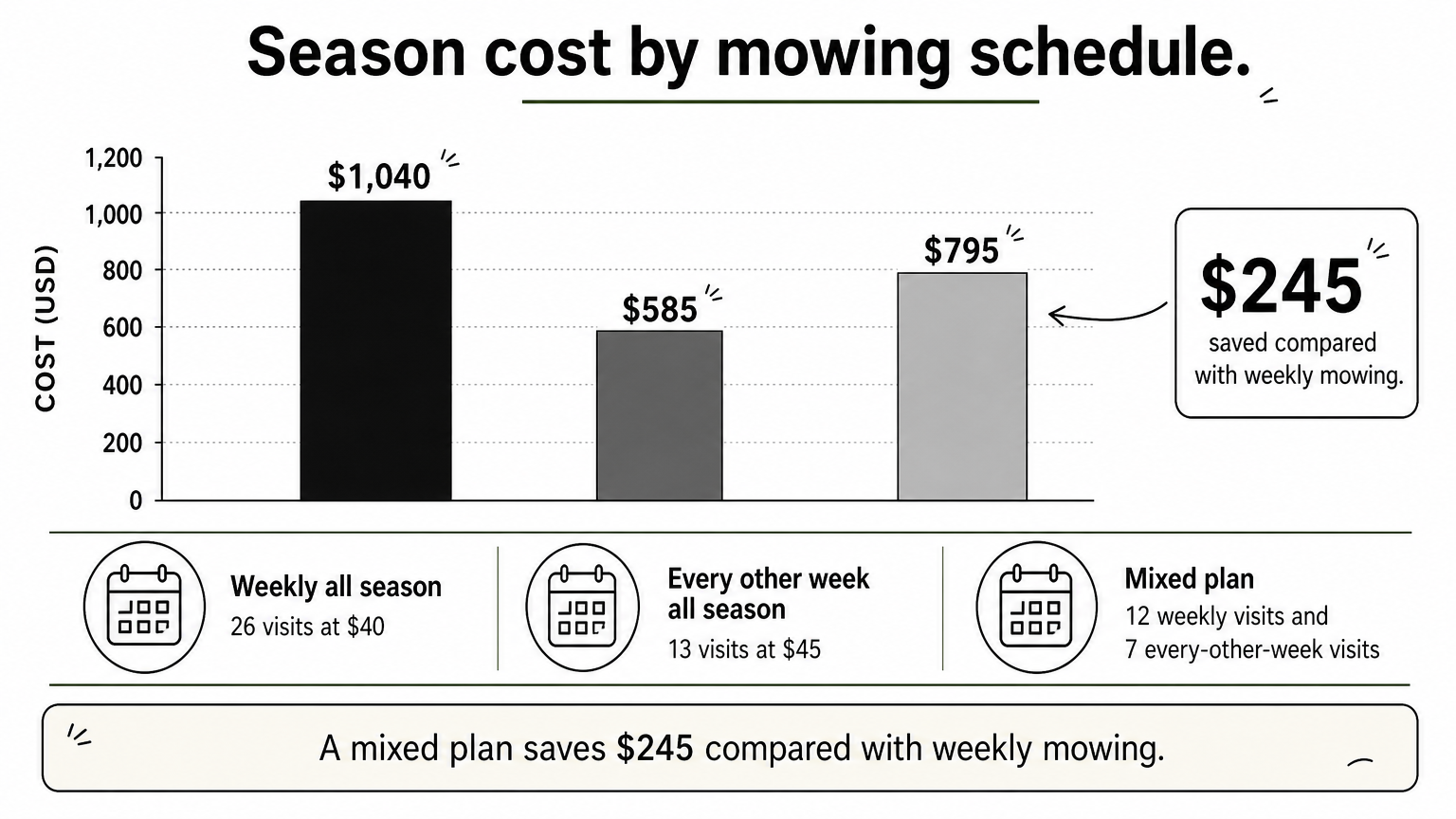
A quarter-acre lot at about $40 per weekly visit costs roughly $1,040 over a 26-week Midlands season, and smart scheduling can cut that by hundreds of dollars. These are illustrative numbers, not a quote.
The assumptions behind the numbers
Assume a quarter-acre lot, which is about 10,890 square feet. Assume a 26-week mowing season from April through October. Assume a weekly visit costs $40 and an every-other-week visit costs $45 , since taller grass takes longer to cut.
The prices are placeholders, so swap in your own quotes. The point is the structure: visits multiplied by price per visit gives your real season cost, whatever the numbers are.
What the numbers show
Three schedules produce very different totals:
| Plan | Visits | Price per visit | Season total |
|---|---|---|---|
| Weekly, April to October | 26 | $40 | $1,040 |
| Every other week all season | 13 | $45 | $585 |
| Weekly for 12 peak weeks, every other week otherwise | 12 weekly + 7 biweekly = 19 | $40 and $45 | $795 |
The mixed plan costs $480 for the 12 weekly visits and $315 for the 7 every-other-week visits. That saves $245 compared with weekly mowing , about 24 percent. Going every other week all season saves $455, about 44 percent, but it risks scalping the lawn in July and August.
The mixed plan is the sensible middle. It trims cost where grass grows slowly and keeps weekly cuts where growth is fastest.
The best deal is the schedule your grass can handle, not the lowest price per visit.
Warning signs behind rock-bottom mowing quotes
A quote far below the usual $30 to $50 range usually means something is missing, such as insurance, trimming, reliability or a fix when something goes wrong. Spotting the gap before you hire costs nothing.
Red flags that raise the real cost
Be cautious when you see any of these:
- The crew cannot or will not show proof of insurance or credentials. Marketplace guidance says to look elsewhere if a pro will not provide it.
- The quote is verbal only, with no list of what each visit includes.
- A large upfront payment is demanded for the whole season.
- The price keeps changing once the crew sees your lot.
- Nobody can tell you who will actually mow your lawn.
Any one of these can turn a cheap mow into a second visit, a damaged sprinkler head or a dead patch you pay to repair.
Questions to ask before you book
Ask every provider the same questions so you can compare answers:
- Are you licensed and insured, and can you send proof?
- What exactly is included in each visit?
- Is the price flat, hourly or per square foot?
- What happens when rain or a breakdown cancels a visit?
- Will the same crew mow every time?
- How do I pause for winter or cancel, and is there a fee?
A provider with clear answers is usually one you can trust. For anything short of that, keep shopping , because a few extra dollars per visit is cheaper than a bad season.
Pay less without paying twice
The cheapest lawn mowing in Columbia is the lowest total cost for a lawn that is cut, trimmed and edged correctly, with someone to call when it is not. Independent crews, neighbor referrals and instant-quote apps can all beat a flat company rate on the sticker. Season-long scheduling, written quotes and proof of insurance are what keep the saving real.
Start by getting three quotes for the same list of tasks, then compare them as season totals using the table above. If you want a local, veteran-owned crew with 20-plus years of experience and a fix-it guarantee, request a lawn mowing quote from Sparta Lawn Care and use it as your baseline.