

How to Find and Hire Reliable Local Lawn Mowing Services
To hire local lawn mowing services you can rely on, measure your lawn and send the same written request to three nearby providers. Compare the quotes line by line, check insurance and the guarantee, and start with a one-month trial. Price matters, but the lowest quote rarely gives you the best deal. The best provider shows up on schedule, cuts at the right height, and fixes a miss without an argument.
The search itself is the hard part. You get marketplace apps, directory listings, and company pages that all promise a low price, yet few say what that price covers. One crew quotes mowing only, while another includes trimming, edging, and blowing. If you hire on the first number, you can end up with skipped weeks, scalped grass, or a different face on the mower every visit.
This guide walks you through the whole decision from a Midlands point of view. It comes from Sparta Lawn Care, a veteran-owned lawn care company with more than 20 years of experience in Columbia and the surrounding area. You will see what mowing should cost and include, then follow four steps: define the job, build a shortlist, vet the quotes, and run a trial.
What local mowing costs and what a visit should include
A typical suburban lot commonly costs about $30 to $80 per mowing visit , and a proper visit includes mowing, string trimming, edging, and blowing . Treat that range as a sanity check, not a quote. Lot size, slope, and obstacles move your number up or down, and you can only compare providers fairly when each one prices the same list of tasks.
What one visit should cover
Providers use the word "mowing" loosely, so agree on what a standard visit contains before you compare prices. A complete visit should include:
- Mowing all turf at the height set for your grass type
- String trimming along fences, trees, beds, and mailbox posts
- Edging along driveways, walks, and patios
- Blowing clippings off hard surfaces
- Leaving gates closed and the lot as it was found
Anything outside that list, such as bagging clippings, leaf cleanup, or bed weeding, is a separate line item. Ask for each extra by name so it does not appear on your invoice later.
What moves the price
Six factors explain most of the gap between two quotes for houses on the same street. Give the provider accurate answers on each one and your quote will hold up after the first visit.
| Factor | Why it changes the price | What to tell the provider |
|---|---|---|
| Mowable square footage | More turf means more crew minutes | Your measured turf area, not the lot size |
| Slope and terrain | Banks and ditches slow the mower and add risk | Steep areas, ditches, ponds |
| Obstacles | Trees, play sets, and beds add trimming time | Rough count of trees and beds |
| Frequency | Weekly cuts take less time than cutting tall grass | Weekly, every other week, or one time |
| Grass height on day one | Overgrown lawns can need two passes | Date of the last mow |
| Access | Locked gates and loose dogs cost time | Gate codes, pets, parking |
A mowing quote means nothing until every provider prices the same list of tasks.
Is hiring cheaper than mowing it yourself?
In cash, mowing it yourself is almost always cheaper. In time, hiring wins. Take a quarter-acre lot with about 7,400 square feet of mowable turf, cut weekly from April through October, which is roughly 30 visits. A crew at $50 per visit costs $1,500 a season . If you mow it yourself, assume a $400 mower spread over five years ($80 a year) plus $150 a year for fuel, oil, blade sharpening, and trimmer line. That is $230 a year.
You save $1,270 but spend about 45 hours, at 1.5 hours a visit including fueling and cleanup. So you pay roughly $28 an hour to hand the work off. These are illustrative numbers, so swap in your own mower cost and your own quotes.
Some providers price by the hour instead of per visit. If a crew quotes two hours of yard work, multiply the hourly rate by the hours, then ask for a flat per-visit price for mowing. A flat price protects you from slow work and is much easier to compare.
Step 1. Measure your lawn and define the job
Measure your mowable area, name your grass type, and write down what you want done, so every provider quotes the same job. It takes about 15 minutes and removes most of the price variation you would otherwise see from local lawn mowing services.
Measure the mowable area
Open Google Maps on a computer, switch to satellite view, right-click a corner of your lot, and choose Measure distance. Trace the length and width, multiply them, then subtract the house, driveway, and beds. Here is the math for a typical lot:
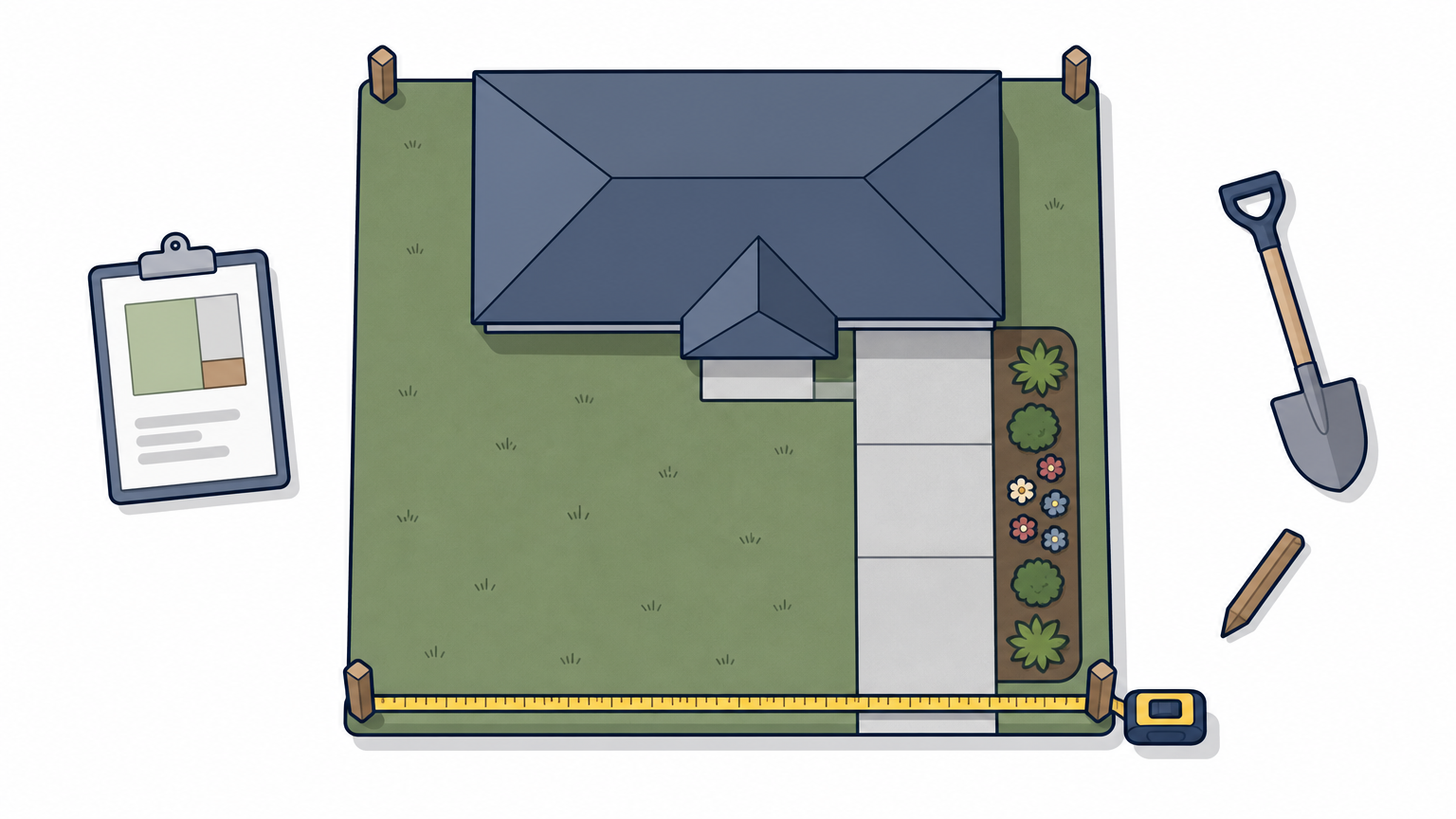
- Lot: 90 ft by 120 ft = 10,800 sq ft
- House and driveway: 2,800 sq ft
- Beds and patio: 600 sq ft
- Mowable turf: 7,400 sq ft
Providers who quote from satellite imagery will land close to this figure. Your own number lets you spot a quote that is off , and it gives you something concrete to correct if they measured wrong. Also note slopes, fenced sections, and narrow gates, because those change crew time more than raw area does.
Name your grass and the height you want
Most Midlands lawns are Bermuda, Zoysia, or Centipede. All three are warm-season grasses that grow hardest from late spring through summer and go dormant in winter. They want to be cut shorter than the fescue lawns common farther north. Typical heights are:
- Bermuda: about 1 to 2 inches
- Zoysia: about 1 to 2 inches
- Centipede: about 1.5 to 2 inches
Tell every provider your grass type and the height you expect. A crew that sets one deck height for every lawn will stress at least some of them, so ask whether the crew knows your grass. Sparta Lawn Care, for example, is familiar with all three.
Send one identical request
Copy this message, fill in the brackets, and send it to each provider by text or email. Identical wording is what makes the answers comparable.
 Hi, I'm looking for weekly mowing from April through October at [your address].
Mowable turf: about [7,400] sq ft. Grass: [Bermuda / Zoysia / Centipede].
Scope: mow, string trim, edge walks and drives, blow clippings off hard surfaces.
Access: [gate code / dogs / none]. Slope: [none / front bank].
Please send: price per visit, what is included, what costs extra, proof of insurance,
your start date, and how and when I pay. Thank you.
Providers who answer every line of that message are usually the ones who run the rest of their business the same way. Treat a vague reply as your first data point.
If you do not define the job, every provider will define it for you, and the price will show it.
Step 2. Build a shortlist of three local providers
Shortlist three providers who serve your neighborhood. Ask neighbors first, check map reviews second, and confirm each company covers your address. Three is enough to see a price pattern and few enough to compare properly.
Start with people on your street
The best leads are lawns you already admire. Ask the neighbor with clean edges which company they use, how long they have used it, and whether the crew arrives on the same day each week . If you live in an HOA, ask the manager, because communities often have crews that already know the common areas and gate access.
After that, search a map listing for mowing near your zip code. Read the newest reviews first and look for patterns about reliability and communication instead of star averages. Then confirm the service area. Sparta Lawn Care, for instance, serves Columbia, Blythewood, Elgin, Chapin, Irmo, Lexington, Hopkins, and Rock Hill.
Know the three provider types
The kind of provider you hire shapes both the price and the risk. None of these is always right, and each makes a different trade.
| Provider type | Strengths | Watch for |
|---|---|---|
| Solo operator | Lower price, direct contact with the person mowing | No backup when sick or when the mower breaks, insurance often missing |
| Established local company | Crews, spare equipment, insurance, written guarantee, regular billing | Higher price, possible minimums or season-start terms |
| App marketplace | Instant online price, fast scheduling | Independent pros are matched to you, so the person and the quality can change |
Cheap local lawn mowing services usually come from solo operators, and some are excellent. Just verify in Step 3 what you give up for the lower price. A crew model also matters more than it sounds. Sparta Lawn Care assigns a consistent, familiar crew to each property, and that crew learns where your sprinkler heads, slope, and dog gate are.
Three quotes on an identical scope tell you more than ten browser tabs of ads.
Step 3. Compare quotes and vet each provider
Compare quotes by real cost per visit and per season, then verify insurance, licensing, and the guarantee before you choose. The cheapest sticker price and the best local lawn mowing service are rarely the same company.
Put the quotes side by side
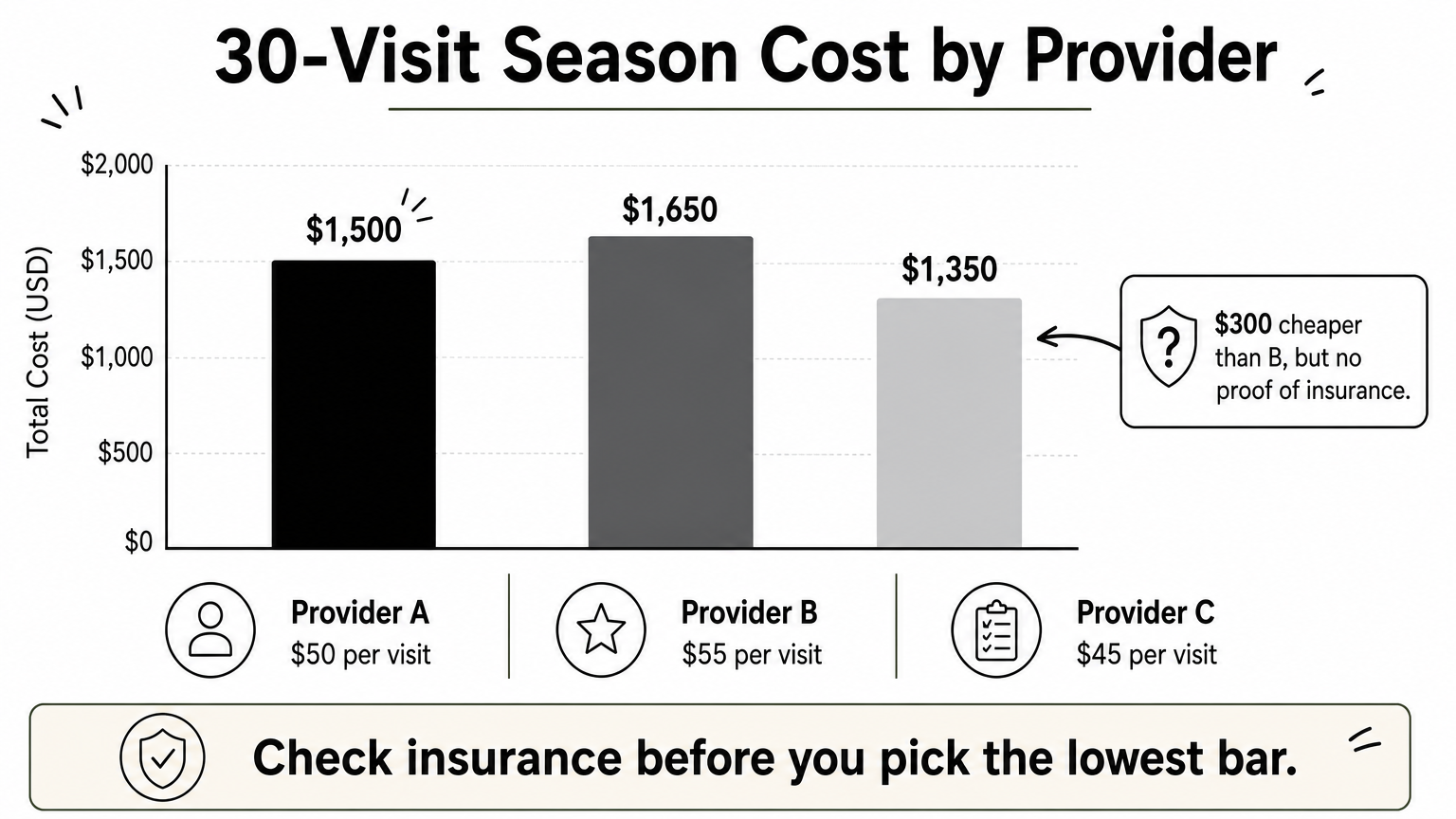
Normalize every quote to the same scope, then multiply by 30 visits. Here is an example for the 7,400 square foot lawn from Step 1. The prices are illustrative, not market data.
| Provider | Quoted price | Extra charges | Real cost per visit | 30-visit season |
|---|---|---|---|---|
| A | $40, mow only | $10 for trim and edge | $50 | $1,500 |
| B | $55, all included | None | $55 | $1,650 |
| C | $45, all included | None, but no proof of insurance | $45 | $1,350 |
Provider A looked cheapest until trimming and edging were added. Provider C is $300 cheaper than B over a season, about $10 a visit, but it cannot show insurance . If a worker is hurt on your property or a thrown rock breaks a window, the cost can end up on you . Whether $10 a visit is worth that risk is your call, but make it knowingly.
Verify insurance, license, and guarantee
Ask every finalist the same short list of questions, and keep the answers in writing:
- Can you email a certificate of insurance showing general liability coverage?
- Do you carry workers' compensation for your crew?
- If you spray weed control, do you hold a South Carolina commercial pesticide license?
- If I am unhappy with a visit, what do you fix, how fast, and at what cost?
- How do I pay, and where do I find invoices and receipts?
The guarantee answer tells you the most. Sparta Lawn Care backs its work with the Sparta Family Guarantee, which promises to fix any service issue at no additional cost until you are satisfied. Whichever provider you choose, get its version in writing. On payment, a client portal gives you a clean record. Sparta takes online card payments through its Secure Client Hub, powered by Jobber. The company is also licensed and insured, which is the standard to hold everyone to.
Pay less without hiring the cheapest
You can lower the price without choosing the weakest provider. These moves work with most companies:
- Give an accurate measured area so the quote does not carry a safety cushion.
- Drop add-ons you do not need, such as bagging, and book them only when you do.
- Ask whether a route that already includes a neighbor's lawn lowers your rate.
- Ask whether mowing and billing pause during winter dormancy.
Skip any provider who demands the full season in cash up front, refuses to write down the scope, or cannot name its insurer. Also resist every-other-week mowing in July, because warm-season grass grows fast enough that long gaps force a scalping cut. Ask for weekly cuts in peak growth and save money elsewhere.
The lowest quote is a bargain only when proof of insurance and a written guarantee sit behind it.
Step 4. Run a trial month and hold the standard
Start with a trial month instead of a season contract, inspect the first two mows against a checklist, and report problems in writing within 24 hours. A good provider welcomes this. A poor one shows itself within four visits.
Set the terms of the trial
Agree in writing on a service day, a rain policy, and how you will be told about delays. Summer storms in the Midlands push mowing back a day or two, and a good crew messages you before it happens . Ask for month-to-month terms at first, with the right to cancel without penalty if the trial goes badly.
Before the first visit, unlock gates, move hoses and toys, and secure pets. If you have shallow sprinkler heads, flag them with small markers. That one step prevents most of the damage claims lawn crews hear about.
Inspect the first mow
Check the first two visits closely. The one-third rule is your main benchmark: never cut more than one third of the blade height in a single mow. If your Bermuda is kept at 1.5 inches, it should be mowed when it reaches 2.25 inches. Centipede kept at 2 inches gets cut at 3 inches. That rule is also why long gaps between visits hurt the lawn.
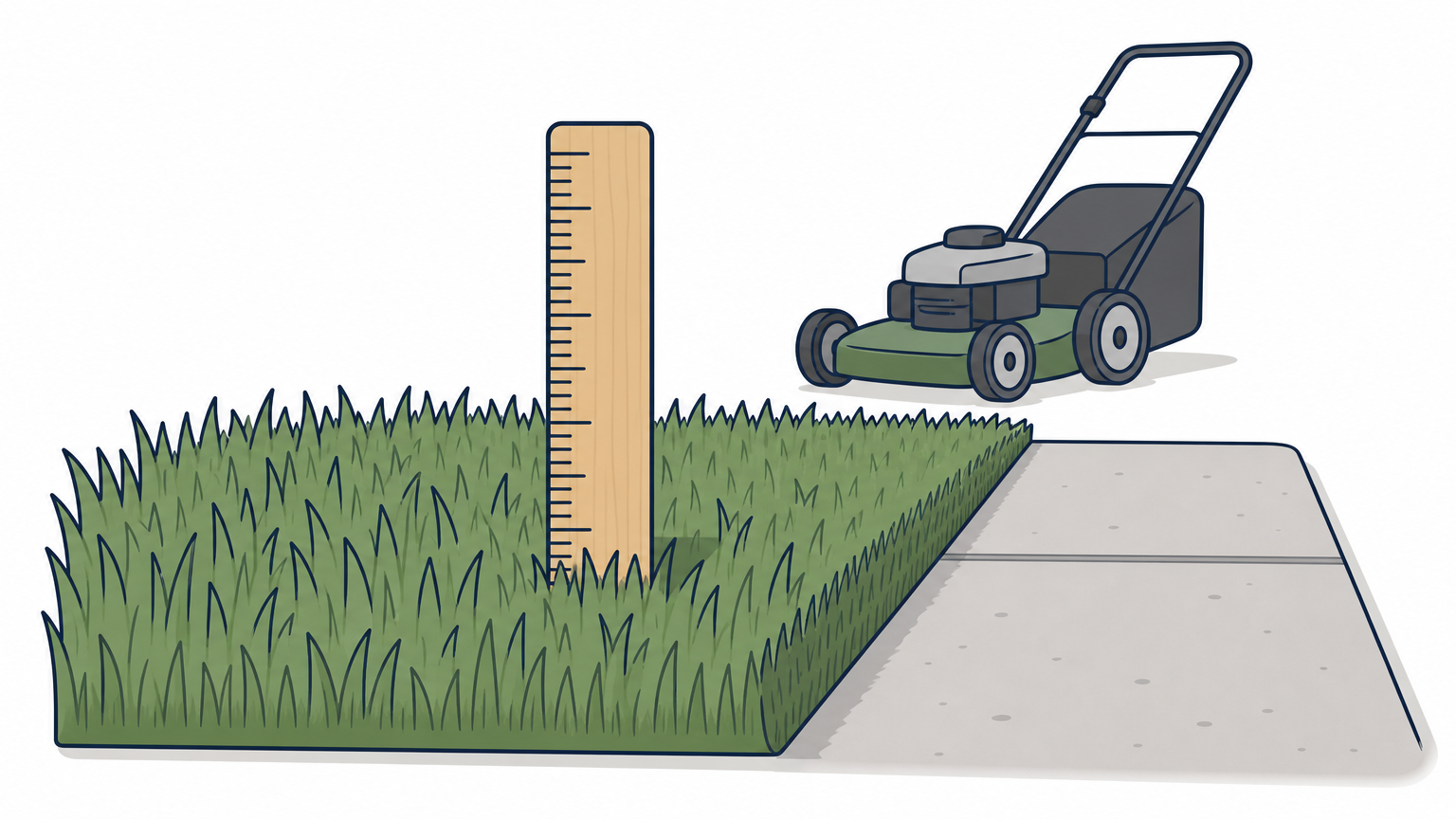
Walk the lawn the same day with this checklist:
- Measure the cut height with a ruler in three spots
- No scalped or brown streaks on high spots and corners
- Clippings blown off the driveway, walks, and street
- Clean trimmed edges along fences and trees, with no nicked trunks
- No damage to sprinkler heads, mailboxes, or beds
- Gates closed and the lot left as you found it
Fix problems quickly and know when to switch
Send a photo and a short message the same day you notice a problem. Give the provider one chance to correct it at no charge, because everyone misses something occasionally. If the same issue shows up twice, switch. Your shortlist from Step 2 means you already have two other quotes to call.
Mowing also slows down once cold weather arrives. Warm-season lawns stop growing in winter, so confirm in writing whether mowing and billing pause . Then decide whether you want to add fertilization or weed control with the same crew in spring, rather than starting another search.
A provider who fixes a miss quickly is worth more than one who never misses but never answers.
Your next step
Hiring good local mowing help comes down to a repeatable process. Measure the lawn, send identical requests, compare real per-visit costs, verify insurance and the guarantee, and trial the winner for a month. Do that and the price you pay buys reliability instead of surprises.
If you are in Columbia, Blythewood, Elgin, or the nearby Midlands communities, you can have us in your comparison. See Sparta Lawn Care's lawn care and mowing services and ask for the same details you demand from everyone else: scope, proof of insurance, and a written guarantee.